What Your Part Really Costs
Why "material plus an hour of labor" gives the wrong price, what makes up the true cost of a product, and how Oprela calculates it from your data: material in purchase form, machines, labor, overhead, quantity, and market.
In many factories, the cost is calculated using a simple formula: material weight times price per kilogram plus labor hours times rate. The formula is clear and fast. The problem is that it's almost always wrong—and it's wrong in different ways for different products, so some orders subtly subsidize others.
Where the Error Hides
Material is not bought by the kilogram. You buy a 3000×1500 sheet or a 6-meter pipe. The part occupies a portion of the sheet; the rest is scrap or usable remnant. The true material cost depends on how parts are nested on the sheet.
Setup is independent of quantity. Setting up a press brake for a new part takes the same amount of time for one piece as it does for a hundred. For a single piece, this can be half the cost.
Different machines—different hourly rates. An hour on a laser costs differently than an hour of manual welding.
Overhead costs. Rent, energy, maintenance, and administration must be distributed; otherwise, the price looks profitable only on paper.
The market changes. The price of steel you entered six months ago might no longer reflect reality.
How Oprela Calculates
Material in purchase form. Costing Studio stores how you purchase each material: sheet dimensions, pipe length, minimum batch. The part cost is calculated considering waste.
Prices with source and date. Every price has an origin (supplier, invoice, date). The system highlights outdated prices. Exchange rates and market indices help keep prices current.
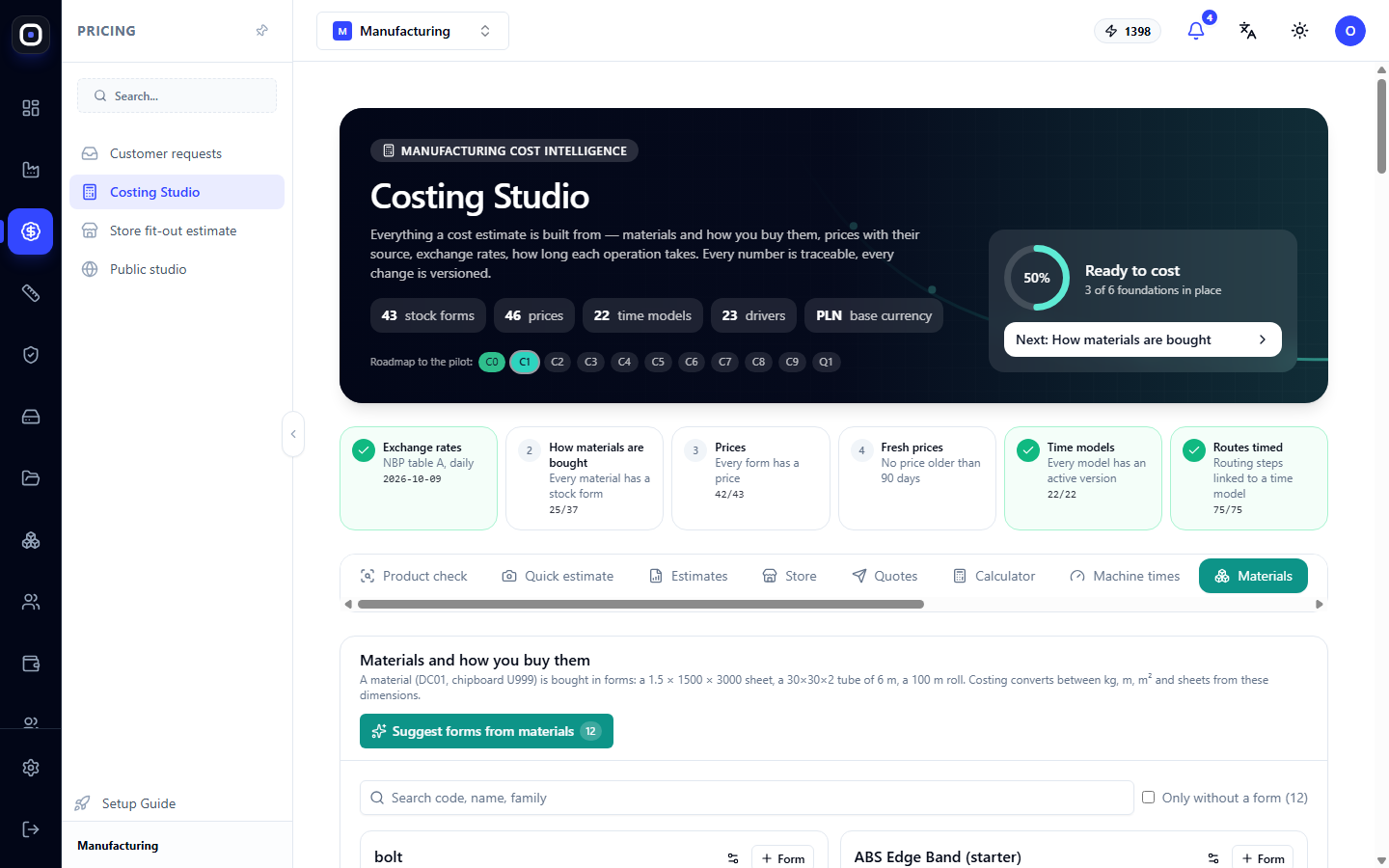
Machine time from geometry. Cutting, bending, and welding times are calculated from the part's shape and specific machine parameters, with separate setup times. More details: How the system calculates operation time.
Rates and policy. Machine and labor rates, overhead, margin, and rounding rules are configured once for the factory.
What Manufacturing Advisor Shows
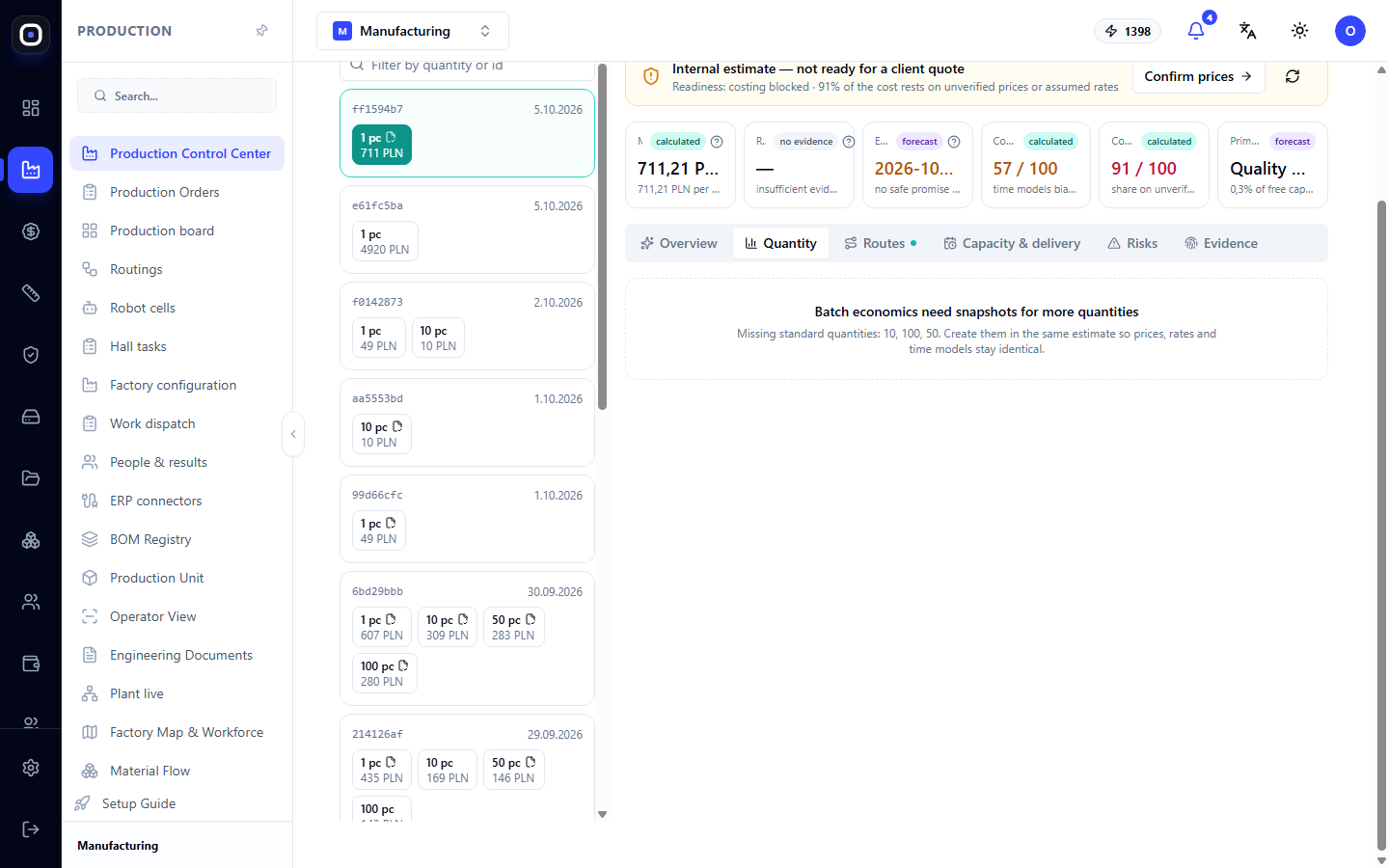
The Advisor breaks down the cost into material, machines, labor, and overhead, showing:
- what most influences the price—for example, welding accounts for 40% of the cost;
- the quantity curve—how the price per piece changes for 1, 10, 50, and 100 units;
- alternative routes—whether the product would be cheaper if made differently;
- risks—what data is missing and how much the result can be trusted.
From Estimate to Actual
The real test is comparing with what happened on the shop floor. Oprela records actual operation times and material consumption, then shows the discrepancy with the estimate. If one operation systematically errs, it's clear which standard needs refinement. With each completed order, estimates become more accurate.
What This Changes
- You see which orders are truly profitable.
- The price for one piece and for a hundred differs justifiably, and you can explain this to the client.
- Steel price increases don't invisibly erode your margin.
- Decisions about new equipment are based on the current cost of an operation.