Oprela Manufacturing for Shop Floor Foreman and Team Lead
Orders on a 3D product map, work distribution from a single screen, status of each batch, delays with reasons, and on-the-fly solutions: replacing defects, changing routes, assemblies for welders. How the system frees the foreman from morning chaos.
A typical morning for a foreman in a manufacturing plant: twenty people queuing with "what should I do?" questions, the phone ringing off the hook with "where are the drawings?", and the daily plan living on a piece of paper that's outdated by lunchtime. The foreman becomes a dispatcher, though they should be overseeing quality and deadlines.
Oprela Manufacturing provides the team lead with two screens that eliminate this chaos.
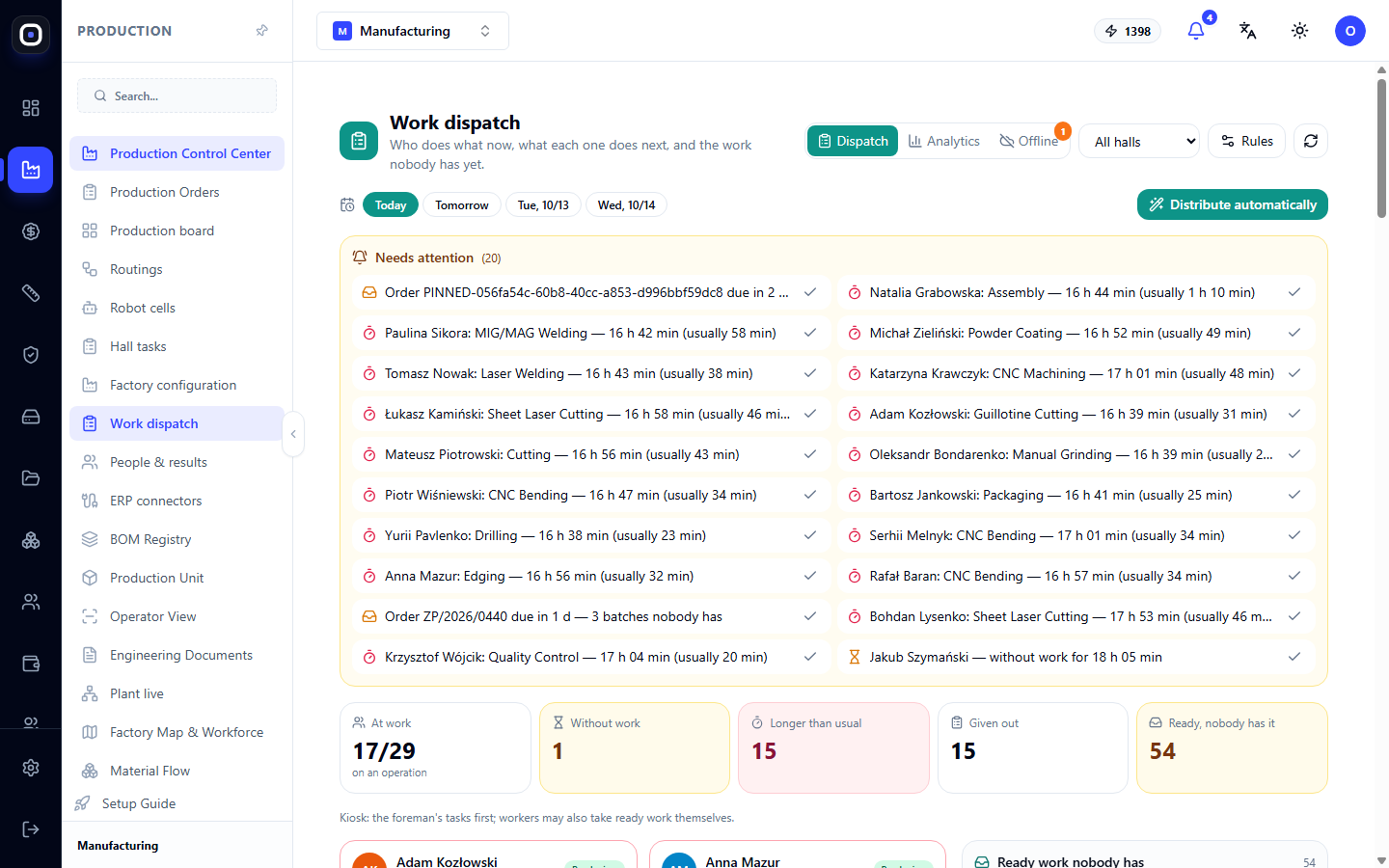
Work Distribution: Who does what and who gets the next task
One screen shows all people on shift, what each person is currently doing, who is free, and which operations are waiting for an executor. The "Needs Attention" block shows who has been working on an operation longer than the norm and where work is stalled.
- Automatic Distribution. The system suggests who should be assigned which operation, considering the person's skills, qualifications, and order priorities. The team lead reviews the suggestion and applies it with a single action.
- Assign and Reclaim. Any operation can be assigned to a specific person or returned to the queue.
- Plan Ahead. Tomorrow's tasks are prepared today, so the morning starts with work, not with distribution.
Foreman's Dashboard: One complete order
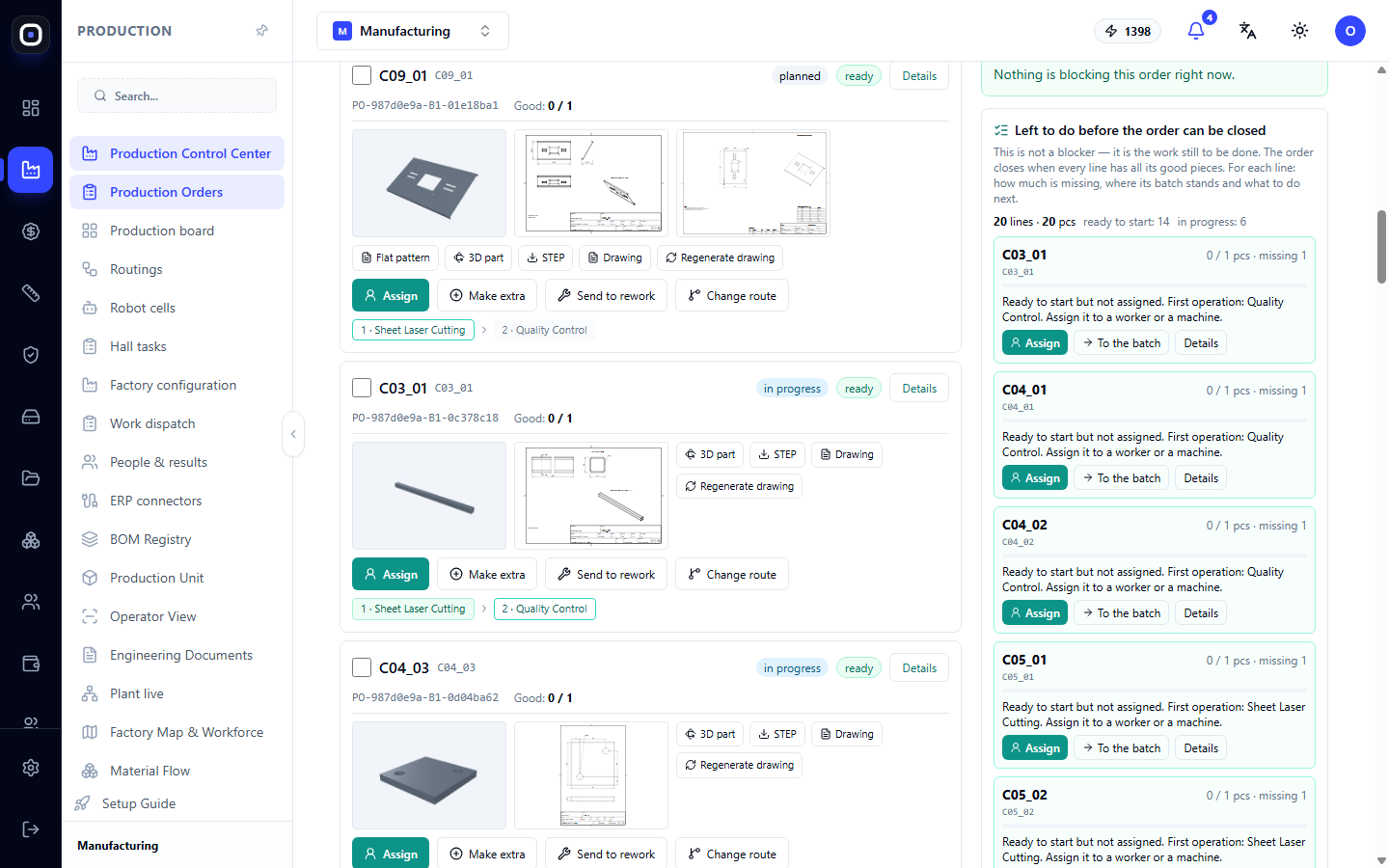
When a specific order needs attention, the team lead opens its dashboard. Here is a 3D product map: each part is colored according to its status — ready, in progress, blocked. Clicking on a part shows its batch, operation, executor, and reason for delay.
On-the-fly Solutions
The shop floor rarely follows the plan perfectly. The dashboard allows decisions to be made where they arise, and each decision is recorded in the history:
- Assign executors to a batch.
- Replace defective parts — create a new unit instead of a rejected one.
- Produce additional units — add units if there's a shortage.
- Change route — direct a part along a different path, for example, to another machine.
- Combine parts into an assembly — define what to weld with what. The welder only sees assemblies created by the team lead, preventing them from welding incorrect parts.
Notifications and Reasons for Delays
The system automatically notifies the team lead when an operation is delayed or a person is idle. An employee who cannot continue working selects a reason: no material, no drawing, malfunction, waiting for a previous operation. The team lead sees the problem immediately, and at the end of the month, management sees statistics on the causes.
Shop Floor Tasks
Not all work on the shop floor involves route operations. Cleaning, material delivery, assistance in another area, machine maintenance are all recorded as shop floor tasks and are assigned, executed, and accounted for in the same way.
What the Foreman Gains
- Mornings without a queue of "what to do" questions.
- A complete picture of the order on one screen.
- Problems are visible before the client finds out about them.
- Every decision is documented: no need to remember who changed the route and why.